
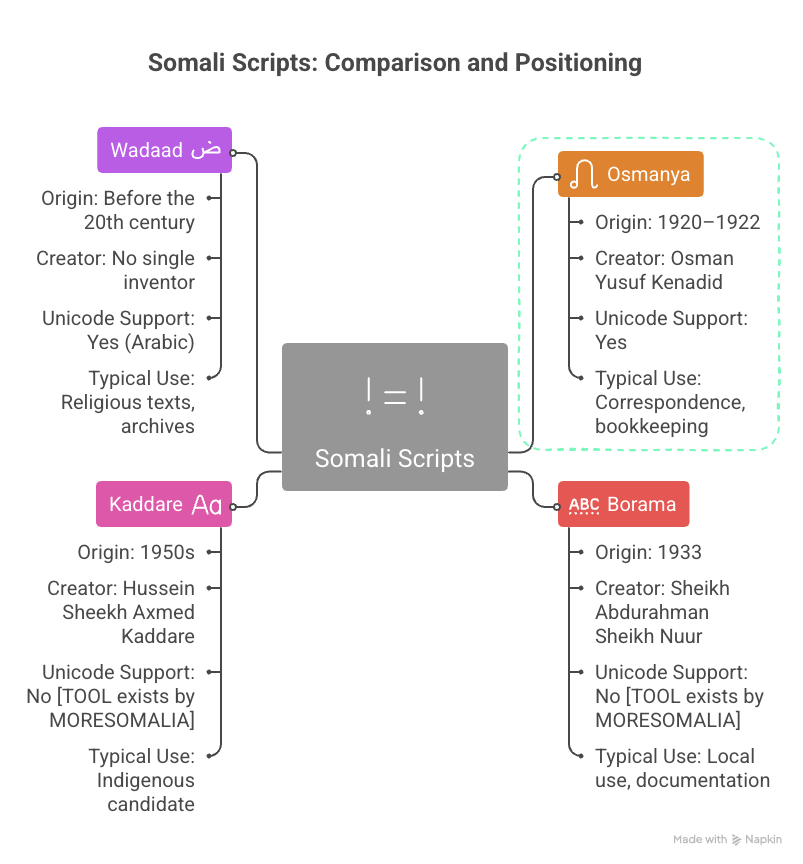
Af-Soomaali (the Somali language) is a cushitic language. It shares similarities with Afar, Saho and other ‘lowland cushitic’ languages in the Horn of Africa. The Somali language wasn’t formally written down until October 1972 when the regular latin alphabet became the standard way of writing. However, different writing systems have been proposed before including Osmanya, Borama, Kaddare, and the Arabic scripts. Of these Osmanya is the most popular!
The Osmanya Alphabet
The Osmanya script is named after its inventor Osman Yusuf Kenadid (the son and brother of the Kenadids ruling in the Hobyo sultanate). It is also called Far Soomaali (“Somali writing”) and was created to transcribe the Somali language in the 1920s.
Below, you will be taken on a tour through Osmanya, so you can master it in the shortest amount of time! You will learn the alphabet using our newly developed Osmanya keyboard, and taking the Osmanya ←→ Latin quizzes. We will take you through the history from invention to decline and possible revival of the script.
The Osmanya Tool by MoreSomalia
Before diving into the details, here’s the heart of this article: I wanted to create a tool that all Somalis can use, when they want to write in Osmanya. Test it out and see how it works!
🇸🇴 Somali Osmanya Transliterator
Convert between Latin and Osmanya scripts. Type or use the on-screen Osmanya keyboard.

The history of Osmanya
Origins and Creation
Osmanya was invented between 1920 and 1922 at the start of a national campaign to settle on a standard orthography for Somali after the Dervish liberation war.
In the early 20th century, many young Somalis felt it was important to have a national script and were reluctant to use the unsuitable arabic script that was the only script used thus far (MOI, 1974). Many felt that the Somali language, unique in the world, should have a unique script. While Osman Kenadid was writing letters to his family using the unsuitable Arabic script, he said to himself:
“You are Somali, you speak Somali, why don’t you have Somali letters?”
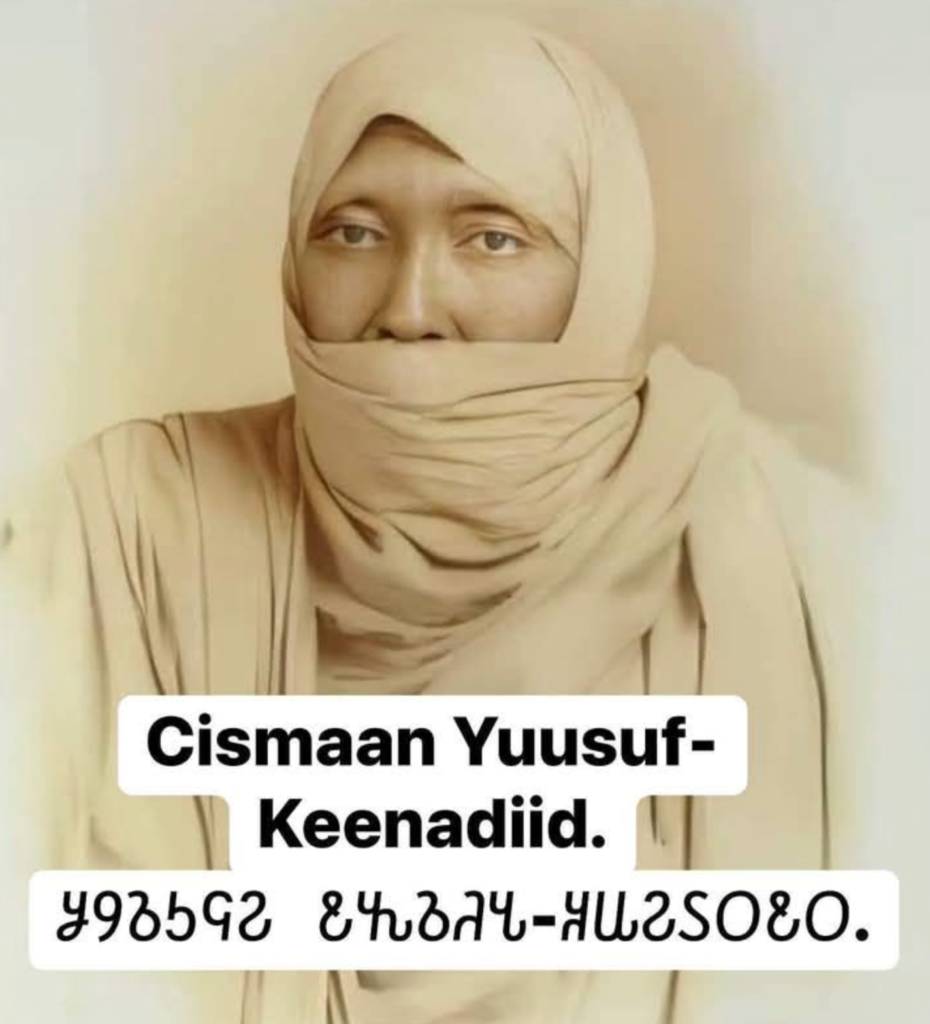
He then developed his own script, which bore no resemblance either to Arabic or to Latin, and began to teach it.
His motivation was cultural and political: he wanted a writing system that was uniquely Somali — independent of Arabic script (associated with Islam and foreign influence) and Latin script (associated with Italian and British colonialism). The script was a point of national pride and identity for Somalia.
Design and Structure
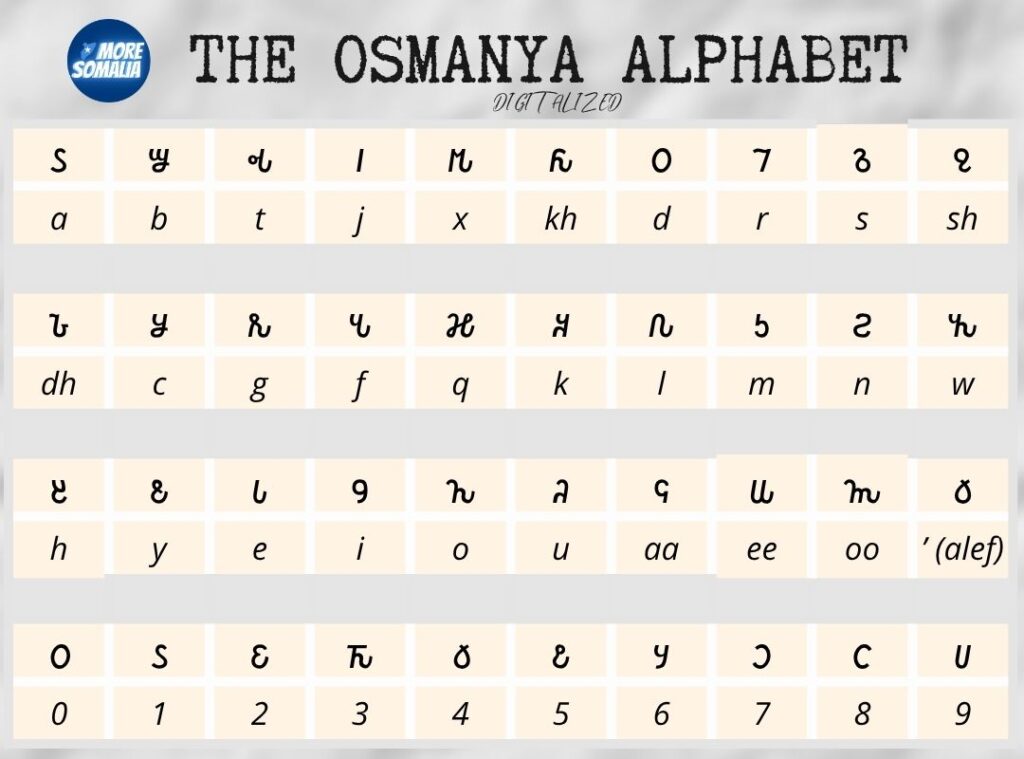
Osmanya is read from left to right, as in the Latin script. It is an alphabet comprising 30 letters and 10 numbers (see the visual below). The order of the letters is inspired from arabic (alif, baa, taa…) but there is no official order. Kenadid’s development of the script prioritized phonetic accuracy, enabling more precise transcription than the prevailing ad hoc Arabic adaptations used in poetry and religious texts. The alphabet was unicoded in 2003, which means that there are official symbols that can be recognized as text on all computers.
| Latin | early Osmanya | late Osmanya |
|---|---|---|
| aa | 𐒖𐒀 ⟨aʼ⟩ | 𐒛 ⟨ā⟩ |
| ee | 𐒗𐒕 ⟨ey⟩, 𐒗𐒗 ⟨ee⟩ | 𐒜 ⟨ē⟩ |
| oo | 𐒙𐒓 ⟨ow⟩, 𐒙𐒙 ⟨oo⟩ | 𐒝 ⟨ō⟩ |
| ii | 𐒘𐒕 ⟨iy⟩ | 𐒕 ⟨y⟩ |
| uu | 𐒚𐒓 ⟨uw⟩ | 𐒓 ⟨w⟩ |
The alphabet was updated after its creation so it contains the long vowel letters (aa, ee, oo). In the early versions of the Osmanya script, long vowel letters were written twice, but later on single characters were developed representing the long vowel letters. At the same time, the “𐒀” Alef used to mark long vowels as well as glottal stop was also dropped from the alphabet.
Quiz 1 of 2) Practice what you learned by translating these latin letters to Osmanya
The big Osmanya Writing quiz !
Can you write these latin letters in Osmanya like the SYL used to do?
Spread, Italian fear, arrest, and decline
Osman Kenadid devised the script to establish a standard orthography for the Somali language. Although it gained considerable popularity, it faced strong competition from both the Latin and Arabic scripts, which were already more widely used and institutionally supported (Southworld). Kenadid’s Osmanya was introduced into the local schools in his Sultanate. Its uses included application in local correspondence, bookkeeping, and early educational texts in Hobyo region schools during the 1920s and 1930s (The language closet).
However, Osman Kenadid’s script faced serious obstacles early on. When Italian colonial authorities became aware of it, they regarded the alphabet with deep suspicion, fearing it was a manifestation of Somali nationalism. Still shaped by the financial and military strain of the Dervish resistance in the preceding decades, the colonial administration in southern Somalia was highly sensitive to any sign of nationalist mobilization.
As a result, Kenadid was imprisoned by the Italian colonial authorities in Mogadishu and the Osmanya script was officially proscribed. His arrest marked the beginning of the script’s decline, leading to its gradual fall into disuse over the following 25 years.
The Somali Youth League (SYL)
After Italy’s colonial rule collapsed in 1945 and Somalia came under British control, independence movements gained momentum. The Somali Youth Club, founded in 1943 in Mogadishu, evolved into the Somali Youth League after the 2nd world war. The League promoted Somali nationalism, including adopting the Somali language and the Osmanya script as the country’s future script.
During the leagues earliest days, younger generations commonly used the script for discrete communication in their political activities. In 1945, the Somali Youth League (SYL) adopted Osmanya as the national script and actively promoted the Osmanya script by teaching it in Mogadishu and beyond. Osman Yusuf Keenadiid’s son, Yaasiin Osman Keenadiid, played a key role as its main advocate and teacher starting in 1945. The League established schools across Somalia and in places like Addis Ababa, Kenya, Zanzibar, and Yemen, spreading awareness of the script. During this period, the script began to be commonly called far Soomaali (“Somali script”) or farta Soomaalida, replacing the earlier name “Osmania.”
Why Osmanya was better than the Arabic script (Abjad):
- It had signs for most of the basic consonantal sounds of the major Somali dialects.
- In the field of the vowels, it had 2 signs more than arabic (“E” and “O”).
- No diacritics: Technically, the Arabic script is an abjad, not a conventional alphabet. Osmanya possessed no diacritics over or under letters as in Arabic (بَ, بِ, بُ).
- Each of its letters was written in the same form in all its three positions and not in three different forms as in the case of many letters in Arabic.
The decline of Osmanya
The Somali Youth League’s push for the Osmanya script faced strong opposition. Many people preferred Arabic over Somali as the national language and were against adopting an indigenous script. As a result, about a decade later the League reversed its position: it removed support for Osmanya from its statutes and instead declared Arabic as the official language of Somalia.
Somalia’s delay in choosing a unified writing system (Osmanya vs Latin vs Arabic) was not just internal confusion, but was actively influenced by external political interference — especially from Egypt (Hiraan).
Afterwards support for the Osmanya script continued through the Somali Language and Literature Society, founded in 1949 by figures including Yaasiin Cismaan Keenadiid. Although it began as part of the Somali Youth League, the Society later became independent and kept promoting Osmanya even after the League abandoned it. The only trace of the Somali language and literature society i could find is this facebook group (https://www.facebook.com/ajoobcosman).
In 1957, the Society launched Sahan (“Explorer”), a small journal written in Osmanya and led by Xirsi Magan. However, there is little evidence of continued Osmanya activity after Somalia’s independence on Somali Independence Day. (Mauro Tosco, 2010)
Quiz 2 of 2) Practice what you learned by translating these Osmanya characters to latin letters
The big Osmanya Reading quiz !
Can you recognize these Osmanya letters? [Osmanya to Latin]
The 1972 Decision and Decline
As you can see Osmanya was used sporadically from 1922 to 1973 for writing the Somali language. It was particularly used between 1961 and 1969, when it was officially approved alongside the Latin script by the newly democratic government (led largely by former SYL leaders). The scientific value of the alphabet was here recognized in the report of the committee appointed by the Somali government following independence in 1961 (Source to the report).
Following the 1969 military coup by Siad Barre, a nationwide literacy campaign based solely on the Latin script led to a sharp decline in Osmanya usage. In 1973, a standardized Latin orthography was adopted as the official script of the Somali language (Scriptsource).
After independence, a governmental commission was set up to decide on an official writing system for Somali. It favoured the Kaddare script (we will soon have an post about that, in sha Allah), but judged it to be impractical for a developing nation. In October 1972, the Somali Latin alphabet was adopted as the official writing system for Somali because of its simplicity, ability to cope with all of the sounds in the language, and the widespread existence of machines and typewriters designed for the Latin script.
The administration of President Mohamed Siad Barre subsequently launched a massive literacy campaign (designed to ensure its adoption), which led to a sharp decline in use of Osmanya.
Osmanya’s resistance as a national script had also been hampered by deeper political tensions. It was identified with the Majeerteen clan, who had supported the Italian colonial government, rather than with the Somali nation as a whole – a view that has changed somewhat in the 21st century. There was also opposition to making Somali rather than Arabic the sole official language of the country, and opposition to using any indigenous script rather than either Arabic or Latin. Despite this, the Osmanya script is still kept alive today.
Resurrection: How unicoding the script, ensured its global preservance
Despite the adoption of other scripts, Osmanya persisted into the 1970s. A notable example is the 1971 primer Afkeenna iyo fartiisa (“Our Language and Its Script”), a 72-page book featuring a portrait of the script’s founder, Osman Yusuf Keenadiid. The PDF of the book can be found in the bottom of this post.
This work was later rediscovered by linguist and font designer Michael Everson after receiving a copy from Keenadiid’s grandson, Osman Abdihalim Osman. Utilizing this text as a primary reference, Everson successfully submitted proposals to encode Osmanya in both ISO and Unicode, ensuring the script’s digital preservation for the modern era.
THIS is why you are able to read, write and copy these letters today : 𐒖𐒁𐒋𐒆𐒗𐒍𐒌𐒔𐒘𐒃𐒏𐒐𐒑𐒒𐒙𐒎𐒇𐒈𐒂𐒚𐒓𐒄𐒕.
Unicoding a script like Osmanya is a massive milestone because it moves a writing system from “historical curiosity” to “functional digital tool.” Before Unicode, a script essentially didn’t exist in the eyes of modern technology. Something that never happened for Kaddare and Borama scripts.
Conclusion
Despite limited adoption, Osman Yusuf Keenadiid’s development of the Osmanya script can be seen as part of a broader movement toward Somali linguistic self-definition. While Osmanya never achieved widespread use, it retains symbolic importance as an example of indigenous innovation and as one of the few independently developed African scripts of the 20th century.
Prior to standardized orthography, Somali culture was predominantly oral, though Arabic-based writing systems were used in limited contexts. Osmanya represented an early and deliberate attempt to accurately encode Somali phonology in a dedicated alphabet, addressing limitations of Arabic-derived systems in capturing features such as vowel harmony and consonant clusters.
Lately, there is some curiosity regarding the Osmanya script. But is there room for a revival of Osmanya and its widespread use? In this blog post our attempt is to make it easier for people to learn and understand Osmanya for the Somali youth. If our tools have been helpful, let us know!
Sources
Among the best early sources for the Osmanya script are Maino (1953), Maino (1951), Ricci (1959), and later on Tosco, Mauro (2010) and Banti, G., & Abdirachid M. Ismail, 2015 describes the Script. Afkeenna iyo fartiisa (“Our language and its script”) is a 1972 book fully in Osmanya attached below.
Hi, I really love the work you did. It’s really impressive, and you can tell there was a lot of research and study behind it. Great job! I’m honestly curious, how do you do all this research and study to create something like this?
Thanks for the this we love ❤️ to see somalia 🇸🇴 history and language documents
Beeldaje noor